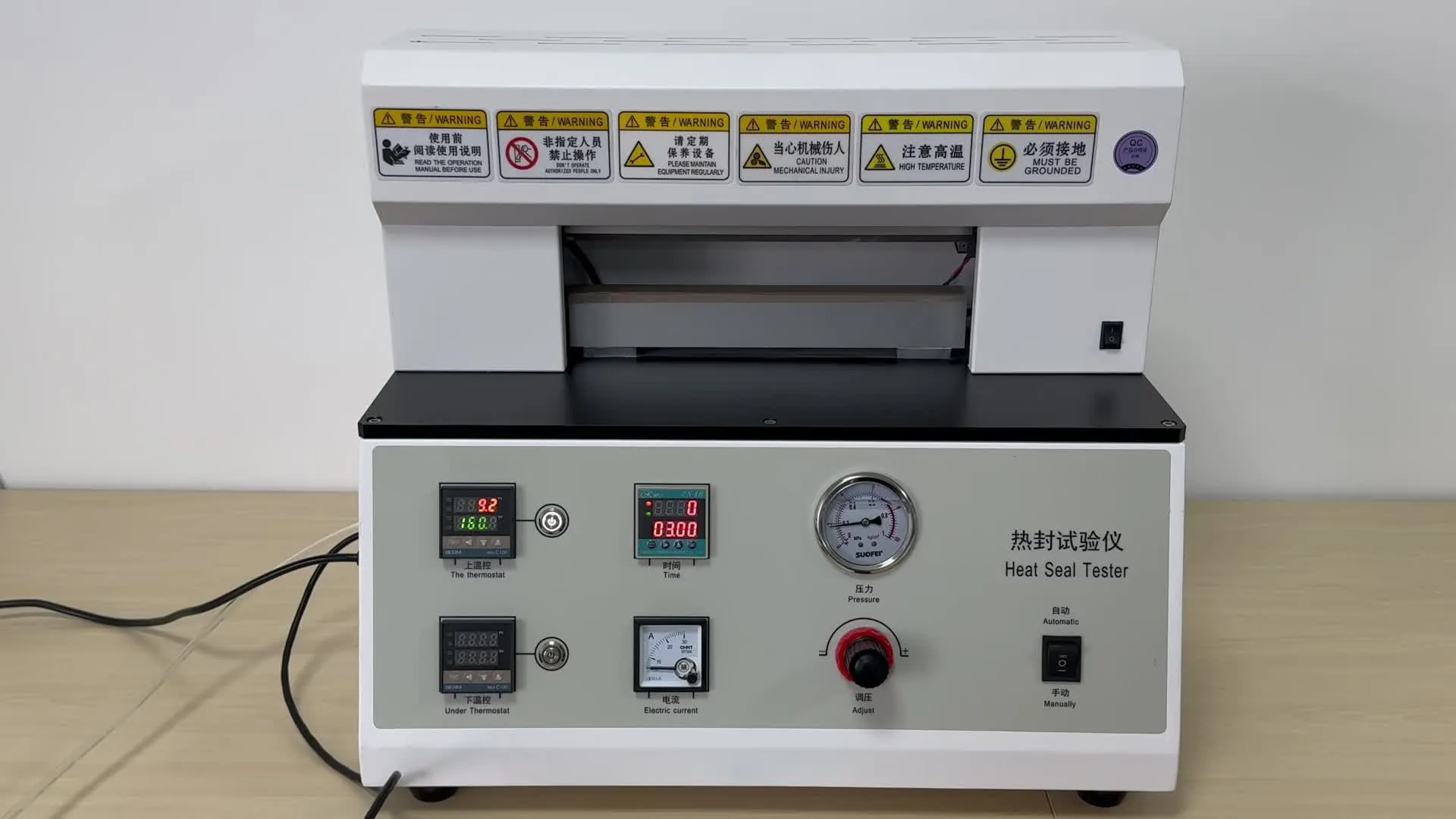
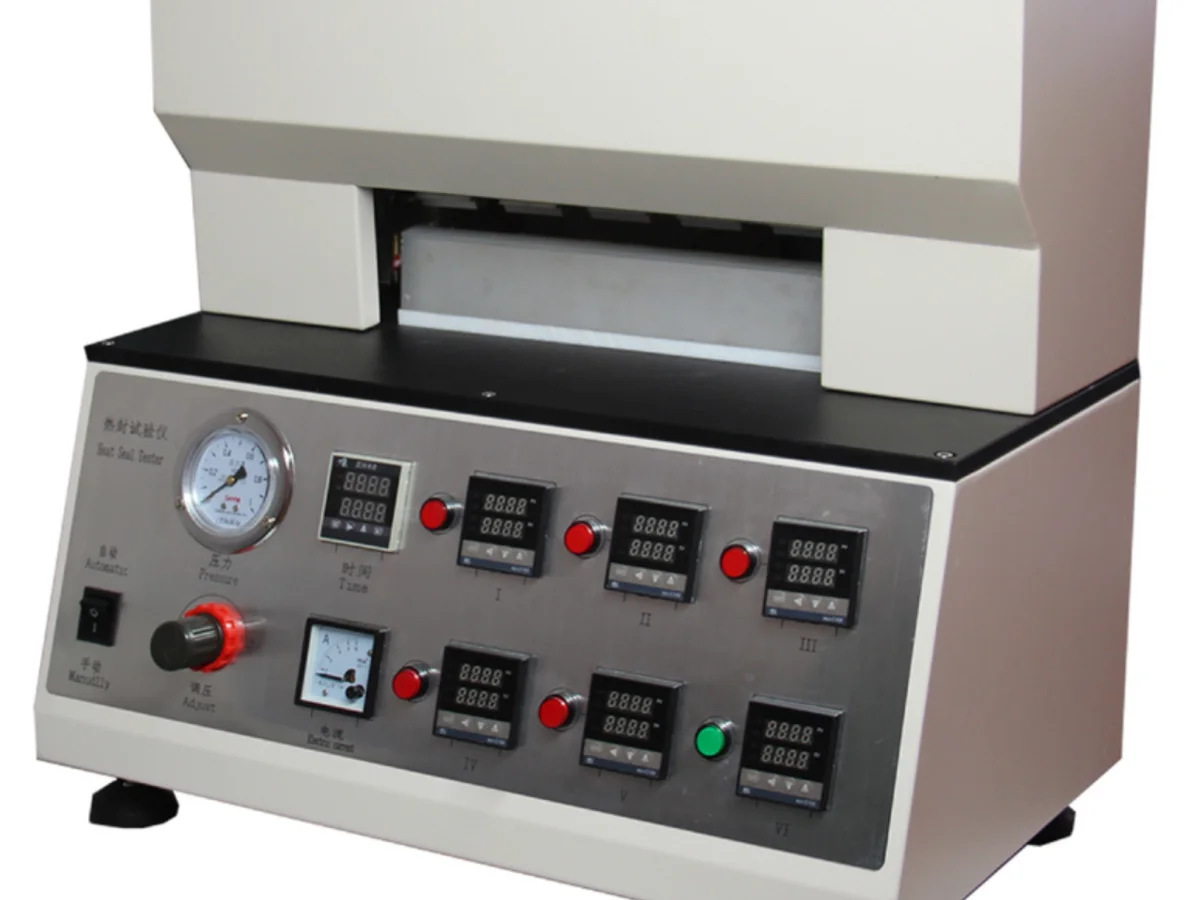
What Is a Battery Pouch Cell Heat Seal Tester?
A battery pouch cell heat seal tester is a laboratory instrument that measures the peel strength and hermeticity of heat-sealed seams on lithium-ion pouch cell aluminum laminate film enclosures. It quantifies the bond strength of the PP inner layer under controlled temperature, force, and dwell-time conditions — without manufacturing new cells.
Before going further, one clarification that matters for engineers evaluating procurement: this instrument is a tester, not a sealing machine. A heat seal tester is a tabletop lab device (approximately 30 kg, 50–500 N load cell capacity) used to measure and verify seal quality. A battery sealing machine is industrial production equipment — floor-standing, weighing 500–2,000 kg — that physically seals pouch cells during manufacturing. The tester measures. The sealing machine makes. This site is about the tester.
Who uses a battery pouch cell heat seal tester? Primarily QA managers running incoming aluminum laminate film inspection, R&D process engineers building seal-strength versus temperature curves for new film suppliers, and materials qualification teams preparing documentation for IEC 62133 certification audits. The primary output metric is seal strength expressed in N/15mm per ASTM F88.
How a Battery Heat Seal Tester Works: Anatomy of the Instrument
A battery pouch cell heat seal tester combines three subsystems. A heated jaw assembly (±1°C accuracy, 80–280°C range) applies calibrated pressure (0.1–0.5 MPa) for a programmable dwell time, creating test seals on 15 mm-wide film strips. A peel/tensile load cell (50–500 N, 0.1 N resolution) paired with a motorized crosshead measures pull-apart force at 300 mm/min per ASTM F88 via 90° or 180° peel geometry. A software module records force-displacement curves, calculates mean N/15mm, and exports SPC-compatible data.
Pouch cell cases are aluminum laminate film (Al-PE-PP composite): nylon/PET outer layer for structure, aluminum foil middle layer as the moisture/electrolyte barrier, and a cast polypropylene (CPP, or PP layer) inner layer that is the heat-sealable surface. During sealing, PP fuses to PP. The tester verifies that bond.
Test workflow in five steps: cut 15 mm strips from the seal zone, mount in a peel fixture, pull at 300 mm/min, record N/15mm, and classify fracture mode. Adhesive failure (PP-to-PP debonding) signals a seal process problem. Cohesive failure (substrate tears before the seal separates) confirms the seal bond exceeds film strength — the preferred outcome.
Why Battery Manufacturers Need a Dedicated Heat Seal Tester
Four pain points consistently drive instrument procurement, all tracing back to inadequate seal process characterization.
Electrolyte leak risk: Seal-related failures account for more than 30% of pouch cell field returns. When the PP layer bond fails during charge cycling, LiPF6 escapes — and in contact with atmospheric moisture it produces hydrofluoric acid. The tester catches weak seals before electrolyte is ever added, at the process qualification stage and at incoming material inspection.
PPM production stability: Large-scale production must hold seal strength within ±5% across thousands of cells per day. A calibrated heat seal tester enables SPC with Cpk tracking — a requirement in IATF 16949-aligned supply chains and EV OEM audits. Without tester data, drift in jaw temperature or film lot variation goes undetected until field returns appear.
Aluminum laminate film thickness matching: Film suppliers offer 88 µm, 113 µm, and 152 µm gauges, each requiring a different sealing temperature. When switching suppliers, the sealing machine's existing setpoint is almost certainly wrong for the new film. The tester builds the temperature-strength curve for each film lot before production begins.
Narrow process window: For standard 113 µm film, the optimal sealing temperature falls within a ±5°C band. Below 170°C, PP fusion is insufficient (< 15 N/15mm). Above 195°C, PP degrades: yellowing, reduced barrier, potential foil distortion. Only a calibrated tester with ±1°C jaw accuracy maps this window reliably.
Common procurement triggers: new film supplier qualification, pilot-to-mass-production scale-up, field return root cause investigation, IEC 62133 certification preparation, and CPP supplier or dwell-time change validation.
Applicable Standards: ASTM F88, IEC 62133, and GB/T References
ASTM F88 / F88M is the primary standard for pouch cell seal strength testing. It specifies 90° or 180° peel geometry, 15 mm specimen width (essential for N/15mm normalization), and 300 mm/min crosshead speed. Outputs are peak and mean force in N/15mm. Any ASTM F88-capable instrument qualifies — the standard defines the method, not the equipment brand.
GB/T 29217 is the Chinese national equivalent of ASTM F88, methodologically identical, and the reference cited in Chinese battery industry incoming QC documentation. Manufacturers supplying Chinese OEMs should reference GB/T 29217 alongside ASTM F88 in their test records.
IEC 62133 governs lithium battery safety broadly. It does not define a peel test method, but seal integrity and electrolyte containment are pass/fail conditions under Section 7.3.x. NIST-traceable calibration records from an ASTM F88-capable tester form the documentation backbone for IEC 62133 compliance.
GB/T 31484 (EV traction battery cycle life requirements) references hermeticity and casing integrity as test criteria — increasingly audited by EV OEM Tier 1 supply chains.
On the production floor, the vacuum pressure decay method complements peel testing: ΔP < 0.5 kPa in 60 seconds is the typical pass criterion. It is a fast in-line screen, not a substitute for the quantitative N/15mm data that ASTM F88 lab testing provides.
KHT HS-Pro Series: Battery-Grade Heat Seal Tester Specifications
The KHT HS-Pro-200 is configured for aluminum laminate film testing in battery applications. Specifications mapped to battery industry requirements:
| Parameter | HS-Pro-200 Specification | Battery Industry Relevance |
|---|---|---|
| Temperature range | 50–280°C (±1°C) | Covers CPP sealing window (175–185°C) |
| Max load | 500 N load cell | Exceeds 152 µm film worst-case requirements |
| Crosshead speed | 10–500 mm/min | ASTM F88 300 mm/min preset built in |
| Specimen width | 10–25 mm | 15 mm ASTM F88 jig included |
| Dwell time | 0.1–30 seconds | Configurable for all commercial sealing conditions |
| Electrolyte soak fixture | Optional | NMP/EC-DMC resistance workflow |
| Data output | CSV, PDF | SPC-compatible; full audit trail |
| Calibration | NIST-traceable certificate | Satisfies IATF 16949 and IEC 62133 records |
The optional electrolyte soak fixture enables a complete resistance workflow: create test seal, measure dry-state peel strength, immerse in NMP or EC/DMC solvent for 24 hours, re-test, and report retention percentage. EV OEM specifications commonly require ≥ 85% retention.
Learn more about heat seal testing across applications at KHT Instrument — Heat Seal Testers.
Seal Strength Data: Typical Values by Film Gauge and Temperature
Process window data from validation trials across commonly used aluminum laminate film gauges provides a starting reference for new instrument users. These values are typical benchmarks — actual acceptance thresholds for any specific film lot must be validated through qualification testing.
Table 1: Seal Strength Targets by Film Gauge (ASTM F88, 90° peel, 300 mm/min)
| Film Gauge | Minimum Acceptance Strength | Typical Production Target |
|---|---|---|
| 88 µm Al laminate (thin, consumer cells) | 18 N/15mm | 22–28 N/15mm |
| 113 µm Al laminate (standard, EV cells) | 22.5 N/15mm | 25–32 N/15mm |
| 152 µm Al laminate (thick, high-capacity) | 26 N/15mm | 30–38 N/15mm |
Table 2: Sealing Temperature Process Window (113 µm Standard Film, CPP Inner Layer)
| Sealing Temperature | Peel Strength Outcome | Process Assessment |
|---|---|---|
| < 170°C | < 15 N/15mm | Insufficient PP fusion — REJECT |
| 175–185°C | 25–32 N/15mm | Optimal process window — PASS |
| > 195°C | Strength variable, barrier degraded | PP degradation risk — REJECT |
Fracture mode interpretation is as diagnostically valuable as the N/15mm number itself. Adhesive failure — where the PP layer debonds from the opposing PP surface — indicates a seal process issue: insufficient temperature, pressure, or dwell time. Cohesive failure — where the film substrate tears rather than the seal separating — indicates the seal bond is stronger than the film, which is the preferred outcome for production validation.
Electrolyte resistance benchmark: An acceptance criterion of ≥ 85% peel strength retention after 24-hour NMP soak is widely used by EV battery manufacturers evaluating CPP film lots. For EC/DMC soak (representative of standard LiPF6 electrolyte carrier), the same retention threshold applies.
Process capability target: For mass production seal processes, the industry target is Cpk ≥ 1.67, corresponding to a ≤ 0.6 ppm defect rate at the seal step. Achieving this requires the temperature-strength curve data that only a calibrated heat seal tester can produce.
Application Example: EV Battery Pack Supplier Film Qualification
An EV battery pack manufacturer in Jiangsu switched aluminum laminate film suppliers mid-production ramp. The new supplier's 113 µm film visually matched the previous material — same gauge, same CPP inner layer designation. The sealing machine continued running at 183°C.
Seal-related QC rejects appeared in the first production lot: adhesive failure (PP-to-PP debonding) exceeding the 500 ppm threshold. The sealing machine itself was operating within parameter tolerances — the root cause was invisible without tester data.
Using a KHT HS-Pro heat seal tester, the R&D team mapped temperature-strength from 165°C to 200°C in 5°C increments. Result: the new film's optimal sealing temperature was 178°C, not 183°C, because the new supplier's CPP used a lower molecular weight PP resin with a lower fusion onset temperature. At 183°C, the PP layer was already in the degradation zone — producing weaker seals despite higher applied energy.
Adjusting the sealing machine setpoint to 178°C brought mean seal strength to 28.4 N/15mm with Cpk 1.82. Seal-related field returns fell approximately 60% over the following quarter.
The principle: the heat seal tester (lab instrument) defines the correct setpoint for the sealing machine (production equipment). They are complementary, not interchangeable.